Thursday, 26 September 2013

Samsung Galaxy S4 preparing its LTE-Advanced

Technology: An optimized 4G compatible with this device will be available before the end of the year, promises the South Korean giant. The promise: 3 Gb / s Theoretical download.
Why change a winning strategy? The hyper-variation of the Samsung Galaxy family home policy will continue, particularly around the flagship of the range, the S4.
After running a mini version, hardened and picture oriented smartphone, the manufacturer now considering equipping its terminal LTE-Advanced, latest evolution of 4G.
The information was confirmed by JK Shin, head of the mobile arm of South Korean giant that evokes a launch before the end of the year. Remember that this still allows optimized 4G boost mobile internet speeds with a theoretical download 3Gb / s ...
Goodbye Qualcomm? 
This incredible speed is made possible by using fewer frequency bands for signal transfer.Already, experiments were conducted in size, particularly in Japan with NTT DoCoMo envisages a gradual migration of its network in 2014.
It is therefore impossible for Samsung to miss this appointment: it is usual to take the field as soon as possible, with a terminal operators to offer, while other manufacturers are much more time to react.
Other interesting information, Samsung abandon its partner for this terminal Qualcomm and turn to Nvidia, Broadcom and ST-Ericsson

Wednesday, 25 September 2013

Samsung will launch a smartphone with a curved screen in October

Technology: Launched in October in South Korean, this new Samsung smartphone is not equipped with a flexible screen, but a curved screen. A new design or just useful gadget?
Korean smartphone giant has reported his research to produce a mobile phone with a flexible screen . But Samsung is also working on other designs, including a smartphone with a curved screen . 
Such a model will also launched before a flexible screen phone, reports Reuters . At a press event in Seoul, Samsung has announced that it would market a curved screen smartphone in October. 
However, the new terminal will be launched in South Korea. The manufacturer has not specified whether he intended to introduce this type of phone in other countries, particularly in Europe. But more important, Samsung has so far provided no information on the specifications of the future curved smartphone. 

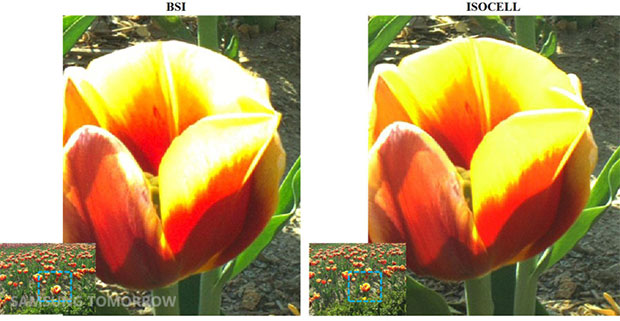
Samsung is preparing a camera ISOCELL for future smartphones

Each manufacturer tries to bring a personal touch to make the camera of their smartphones as good as some phtos digital devices found on the market from these manufacturers include HTC with its ultraPixel (you can find on HTC One example), Motorala with his clearpixel (available on the Moto X) and not forgetting the Sony G Lens.
Because everyone gets started, there is no reason why Samsung does not do the same. Indeed, the Korean company has introduced a new technology that will be named "ISOCELL" and it will equip the next high-end smartphone from Samsung.
To stand out, Samsung has formed a physical barrier between the pixels in order to isolate them to collect more photons than the BSI sensors now, and to increase the image quality to more 30%.It is also indicated that future smartphones will also switch to the 8 MP, which will have large pixels as is already the case with the HTC One where even the iPhone 5S.
samsung ISOCELL 2409
Finally, Samsung says the S5K4H5YB (serial number of the sensor) that use a pixel ISOCELL 1.2 microns with an optical format of 1/4 inch will come into production as early as the fourth quarter of this year. This means that this new type of camera to equip the next Smartphone Smartphones of 2014. It should be noted that the System Research research firm Techno provides a photo camera at least 8 MP of 66% of high-end smartphones that come out next year.

Tuesday, 24 September 2013

Design of Samsung Galaxy Mega 6.3


Design

We remember criticism when exiting the Galaxy S3 ! The worst of the critics said that the smartphone was the Fiat Multipla of telephony, others argued forcefully that the device was designed entirely to escape the patents held by Apple. A device designed by lawyers than by designers , in fact. Anyway , since the Galaxy S3 , Samsung has very little developed its line : the Galaxy S4 is a square but strongly similar hair , and the Note 2 Mega echo the design and increase the proportions just .

We thus find a block of soft plastic , this time in colossal measurements . As usual with Samsung, even if the materials are very cheap , the precise finishing . Sure, this is not a unibody device , and the glossy plastic is clearly not pleased everyone, but we must recognize that we honestly do not have before us a low-cost model.


The corners are always rounded but given the size of the craft , the curves are less pronounced : we fall back on a more rectangular shape , which is not unpleasant . The front and back of the device are the same reasons, a very fine grid , which in the front is so narrow that it appears more like a set of neat points. Samsung requires , of course you will find the physical button on the front that fans enjoy. To right and left are the back and menu buttons, the manufacturer did not give guidelines of Android that rather invites brands to offer multitasking buttons, the "menu" is virtually built into the OS key.

At the front always, you will find a light emitting diode , who will notify you of your notifications and proximity sensors and light. Everything is very well integrated , as are the two photo sensors , front and rear . Of course , the back is completely removable to allow you to access the SD card, the SIM slot and battery . The flash is placed under the sensor. Slices, as the Galaxy S4, are an imitation aluminum ' that will not long illusion once in hand .


More of the same ? Exactly : the Mega 6.3 is the spitting image of Samsung , without any innovation or risk-taking. The stylus port is found on the Galaxy Note has disappeared, since there is more stylus.


Samsung will be there the first manufacturer to launch a mobile Android with 64-bit architecture?

2014 will undoubtedly be marked by tilting the mobile processor to 64-bit, and the trivialization of RAM 3 GB In reality, there is a predictable improvement given the escalation of remarkable power on mobile devices the time, in the same way as our old PC there a few years ago. The question that may arise is: What first manufacturer out the first Android smartphone or tablet with this performance?

There are a few days after the official release of the iPhone 5S, Samsung has confirmed that it plans to launch a computer running a 64-bit device next year. A processor that seems to be obviously homemade, because it seems that the South Korean firm is currently working on a Exynos 64 bits, and an internal source of the firm states that the processor is being finalized. This means that the processor can already be installed on a smartphone or tablet to perform tests.


Therefore, we can say that the hardware is almost ready, and the worst is yet to do is to tell the operating system to adapt to this new 64-bit architecture. On this point, we have had confirmation from the director of the Linux Foundation that the Android operating system is inherently compatible with this new architecture since it is based on a Linux kernel.

However, one must take into account the development of the applications so that they take full advantage of this new architecture. An architecture that is normally upward to 32-bit OS Android, but that it must undergo some changes to make it fully compatible with 64-bit architecture. In fact, the goal is to provide an OS that is fully compatible with existing 32-bit, but can switch to 64-bit when needed.

In any case, every reason to believe that the first unit equipped with a 64-bit processor is the Samsung Galaxy S5 which is to be announced in April or May of next year. Anyway, it remains to be seen whether Google has officially announced compatibility with 64-bit architecture for its mobile operating system at the announcement of Android 4.4 KitKat is normally scheduled for the month of October.


Saturday, 21 September 2013

Introduction to Samsung Galaxy Mega 6.3 features, specifications


Always bigger! Is that Samsung will stop one day? After two generations of Galaxy Note and Galaxy Mega 5.8 disappointing, the Korean giant has decided to push the limits of your pockets and your hands by offering a Galaxy Mega 6.3. 6.3 is actually in inches, the diagonal of the screen.

If you do not like large smartphones, you can now stop reading this test, we're not going to convince you.Samsung embarks on a quest for excess and intends to satisfy its series with Mega users who were not satisfied with the series score. The Mega is not better equipped, they are not equipped with the stylus function: there are other arguments that Samsung will try to highlight.


But then here, knowing that we already saw a big Galaxy S2 at its output can do we push the relativism of measurement further? Samsung did not wait for others to try it: as in almost all sectors of the phone, it was to be the first of many sizes and deliver massive flooding in fact the market an ever greater choice when Apple will settle for a model year or HTC and Sony, a flagship model and some variations. Samsung is a steamroller and intends to stay.

Quickly evoke the technical details of this unit. Hardly used smartphones equipped with 5-inch screen, along comes a generation of devices even bigger ... or rather huge. Measurements of 6.3 Mega are: 167.6 x 88 x 8 mm for 200 grams. It remains quite thin, but its weight is well above average.

The 6.3 inch screen is not AMOLED from Samsung, but a Super Clear LCD. Unlike high-end devices 2013 that are in Full HD, the Galaxy Mega has a resolution of 1280x720 pixels or HD. Given the size of the screen, this gives a rate of pixels per inch rather low, of the order of 233 dpi. For comparison, a Galaxy S4 himself has 441 pixels per inch, almost double.

In the bowels of the beast, this is not the high end: found a 400 dual-core Snapdragon processor clocked at 1.7GHz and accompanied by an Adreno 305 graphics processor. The duo will rely on 1.5 GB of RAM and be able to support 8 GB of internal storage, expandable via microSD card up to 64 GB Note rare thing, a 4GB microSD card is provided. It's better than nothing!

The camera is a standard last year: we find an 8-megapixel rear and a 1.9 megapixel webcam on the front.Autofocus, digital zoom, burst mode is the game. This also allows the Smartphone to capture video in Full HD 1080p at 30 frames per second. Beyond that, there are all the little internal standard accessories now: GPS, gyroscope, light sensor, proximity sensor, NFC etc.. Finally, note that this is a 4G LTE compatible smartphone.

Box Contents


You have a beautiful wooden box Samsung imitation. The rest is classic, with a little surprise nonetheless.

• A Samsung Galaxy Mega 6.3
• A wired stereo handsfree with earphones and several tips that have good air quality - we'll see how it is in practice
• A microUSB cable
• A charger
• A 4GB microSD card and a microSD to SD adapter
• The quick start manual and some papers

Samsung has opted for a PenTile display on the Galaxy Note 3


Immediately after the announcement of the Galaxy Note 3, debates on the screen that Samsung has opted for this animated phablette different forums, wondering if the South Korean firm used a PenTile screen or RGB on this type terminal. It turns out that the Galaxy Note 3 is finally equipped with a PenTile display.

To summarize, the difference between a PenTile display and RGB is in the sub-pixel. Indeed, the PenTile display uses much of alternating red and blue color in the RGB pixel, offering even better pixel density is still visible to the naked eye. You can also see the difference in the image below in the left is the RGB display and one on the right, PenTile.


Then, it should be remembered that the Galaxy Note 2 uses RGB technology, while the Galaxy S4, with the PenTile subpixel shaped diamond. There has recently been some confusion on the type of view adopted by the Galaxy Note 3 , but eventually, the Korean company has confirmed that its latest smartphone uses the same display technology as the Galaxy S4.


Galaxy S4

However, the PenTile display has not always had a good reputation as the screen of the Galaxy S3 is also Pentile proposed a halo around the edges of the elements of the display as you can see in the following.


However, changing the pixel density made it impossible to see every pixel of the screen, pushing the PenTile display to a whole new level. To illustrate this, you can see the series of images that allows you to see the actual difference between PenTile and RGB display.


Galaxy Note 3


Galaxy Note 2


Galaxy S4


Galaxy Note 3


Galaxy Note 3

In addition, it should be noted that the difference between PenTile and RGB does not affect the user experience. The difference lies rather in the life, the energy consumption and the cost of production.